Jan 30, 2026
Voice AI Automation: Complete Guide for Consumer Lenders
Voice AI automation for consumer lenders: how AI voice agents handle collections, disputes, and customer service with compliance controls built in from the start.
Voice AI automation uses artificial intelligence to handle phone calls without human agents, understanding natural speech, responding in real time, and taking action in connected systems during the conversation. It's a step beyond traditional IVR menus and basic chatbots.
This guide covers how AI voice agents work, what capabilities to look for in a platform, and how regulated industries like consumer lending deploy voice AI with compliance controls built in from the start.
What is Voice AI Automation
Voice AI automation is software that handles phone calls using artificial intelligence instead of human agents. It uses natural language processing and machine learning to understand what callers say, figure out what they want, and respond in real time. Unlike traditional IVR systems that force callers through "press 1 for billing" menus, voice AI automation carries on actual conversations.
Modern AI voice agents like Salient's Taylor understand intent, handle interruptions, and take action in connected systems while still on the call. A caller can ask about their balance, make a payment, and set up a reminder, all without talking to a person or navigating menus.
Four components work together to make this happen:
Speech-to-text: Converts spoken words into text the AI can process
Natural language understanding: Figures out what the caller means, not just what words they used
Response generation: Creates natural-sounding replies in real time
Action execution: Performs tasks in backend systems during the conversation
How AI Voice Agents Work
Understanding how AI voice agents function helps clarify what separates a capable platform from a basic chatbot with a voice layer added on top.
Natural Language Understanding and Response
AI voice agents don't match keywords to pre-written responses. They interpret meaning. When a caller says "I can't make my payment this month" or "things are tight right now," the AI recognizes both as the same underlying intent, even though the words are completely different.
Speed matters here. Conversations feel natural when responses come within a few hundred milliseconds. Longer delays create awkward pauses that make callers hang up or assume the system is broken. The best systems also handle interruptions gracefully. When a caller talks over the AI, the agent stops, listens, and adjusts, just like a human would.
Borrower-Level Memory Across Interactions
Generic voice AI tools treat every call as a blank slate. That's a problem when someone calls back about an issue they raised last week.
More capable platforms retain context across interactions. The AI knows what was discussed before, what promises were made, what hardship notes exist, and what actions were taken. A borrower who explained a job loss two calls ago doesn't have to repeat that story. The agent already knows and can skip straight to solutions.
Salient's Taylor agent uses this approach. Every interaction is informed by the borrower's full history, including prior calls, promises, disputes, and claims.
Real-Time Action Execution in Connected Systems
Answering questions is table stakes. The real value comes when AI voice agents actually do things.
During a single call, Taylor can verify identity, look up account status, process a payment, set a callback reminder, update a due date, and write all of that back to the loan servicing system. The caller hangs up with their issue resolved, not with a promise that someone will call them back later.
AI Voice Agents for Regulated Industries
Voice AI automation has unique requirements in regulated sectors. US consumer lending is a clear example. Lenders face supervision from the CFPB, OCC, FDIC, NCUA, and state regulators. AI that works in this environment looks different from AI built for general enterprise use.
Compliance Requirements for AI Calling in Lending
Several regulations govern how lenders can communicate with borrowers:
FDCPA: Rules for debt collection communications, including required disclosures and prohibited practices
UDAAP: Prohibition on unfair, deceptive, or abusive acts or practices
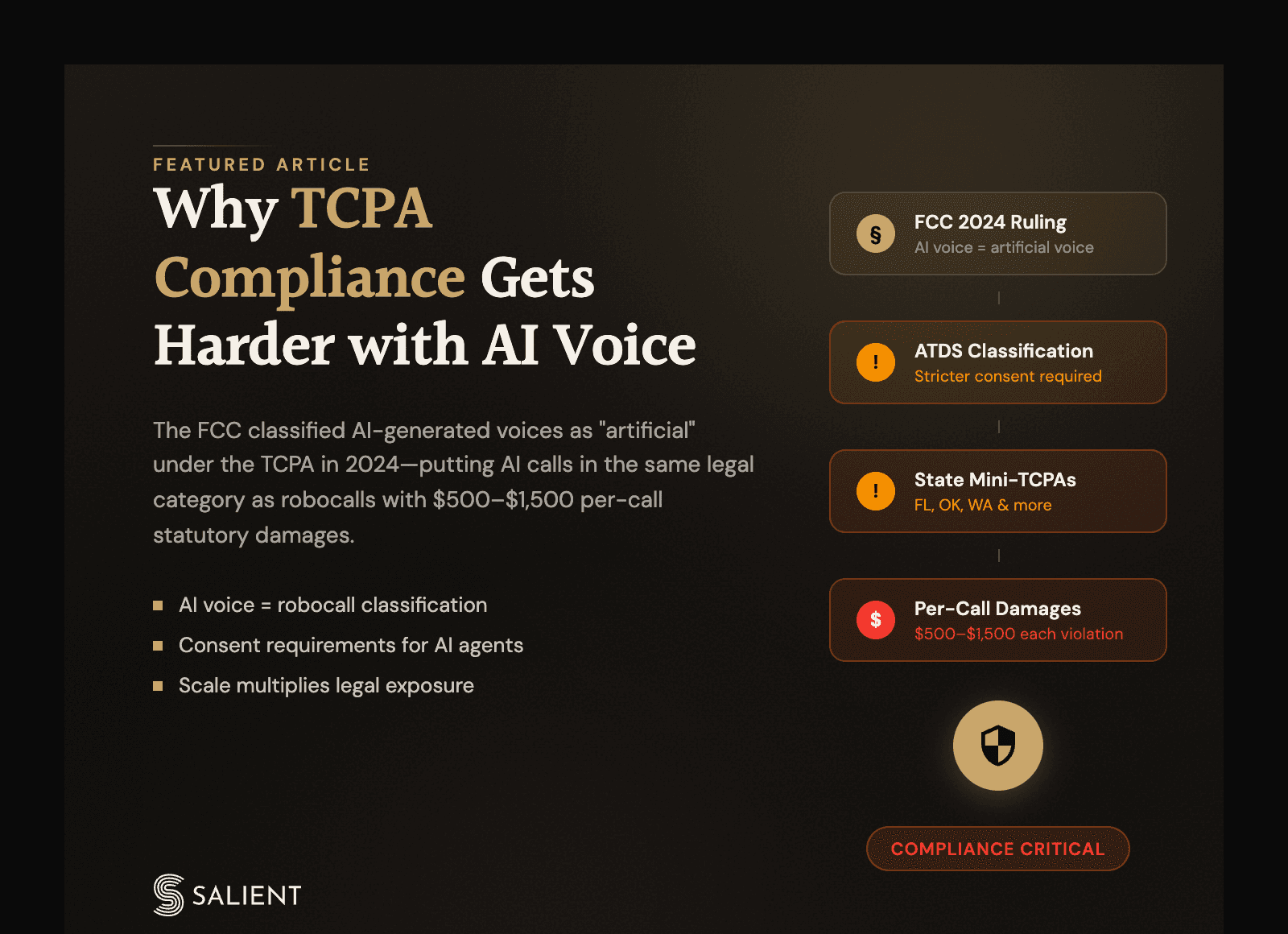
TCPA: Restrictions on automated calls and texts, including consent requirements
State regulations: Varying rules by jurisdiction on contact frequency, licensing, and disclosures
Salient's Taylor handles these requirements automatically, not as an afterthought or a checklist someone reviews later.
Guardrails and Controls for AI Phone Agents
Configurable controls govern what Taylor can and cannot do. These guardrails are set before deployment and enforced automatically during every call.
Prohibited phrases: Words or statements the AI will never say
Required disclosures: Statements delivered at specific points in the conversation
Contact frequency caps: Limits on how often a borrower can be contacted
Time-of-day restrictions: Rules based on borrower location and local regulations
Escalation triggers: Situations that automatically route to a human agent
When guardrails are built into the platform, compliance becomes a system property rather than a training problem.
Audit Trails and Evidence Packs for Examiners
Regulators and internal auditors want to know what happened, what was said, and why. Compliant AI voice platforms log everything at the interaction level.
This documentation supports exam preparation and internal review. Salient provides one-click evidence packs. Teams can export exactly what examiners ask for without manual assembly or scrambling before an audit.
Key Capabilities of an AI Voice Agent Platform
A full-featured platform handles more than one type of call. The distinction between inbound and outbound matters, and so does the difference between conversation and workflow automation.
Inbound AI Voice Agents for Customer Service
Inbound agents handle calls that come in: account inquiries, payment questions, due date changes, verification requests, and general support. They're available around the clock without hold times or staffing constraints.
For high-volume operations, inbound AI can handle routine calls without human involvement. The remaining calls route to human agents with full context already captured.
Outbound AI Callers for Collections and Payments
Outbound AI initiates calls rather than waiting for them. Common use cases include payment reminders, promise-to-pay follow-up, early-stage collections, and appointment confirmations.
Many of these calls go unanswered or to voicemail. AI callers can work through large call lists efficiently, reaching more borrowers than human teams while maintaining consistent messaging across every conversation.
Back-Office Workflow Automation
This is where voice AI automation delivers outsized value. The AI doesn't just talk, it executes entire workflows from start to finish.
Consider a dispute: Taylor can intake the claim, gather required documentation, check eligibility rules, update the servicing system, and confirm next steps with the caller. Or a total-loss claim: from first notice through investigation to final settlement, the AI manages each step. Salient's agents are built specifically for end-to-end workflows like these in lending operations.
Omni-Channel Communication Across Voice, SMS, and Email
A single AI agent can handle multiple channels with shared context. A borrower who starts a conversation via text and later calls in doesn't have to repeat themselves. The AI already knows what was discussed.
This consistency matters for customer experience and for compliance. Every interaction, regardless of channel, follows the same rules and gets logged the same way.
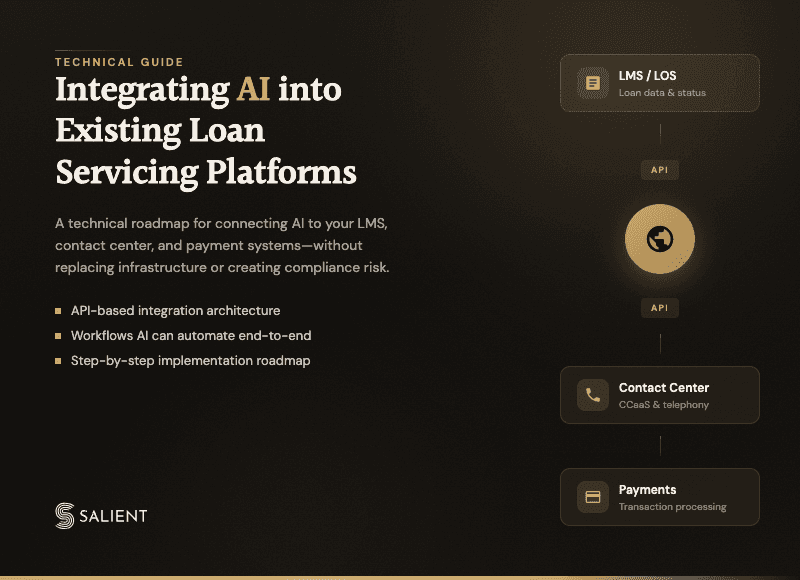
How AI Voice Agent Platforms Integrate with Existing Systems
A common concern: will this require ripping out existing infrastructure? For well-designed platforms, the answer is no.
Loan Management and Servicing Systems
Integration with LMS and LOS platforms enables real-time data access. Taylor can see account status, payment history, and borrower details, and write outcomes back after the call. No manual data entry, no delays.
Contact Center Platforms
AI voice agents connect to existing CCaaS infrastructure. This allows hybrid deployments where AI handles routine calls and humans handle escalations, all within the same contact center environment teams already use.
Payment Providers
Integration with payment rails lets AI voice agents process payments, set up autopay, and confirm transactions during the call. The borrower doesn't get transferred or told to call back.
Business Outcomes from AI Voice Automation
Lenders deploying Salient's Taylor are seeing measurable results across collections and customer service operations:
Outcome | What It Means |
|---|---|
Call coverage | Handle more calls without adding headcount: nights, weekends, overflow |
Containment rate | Resolve conversations without human transfer |
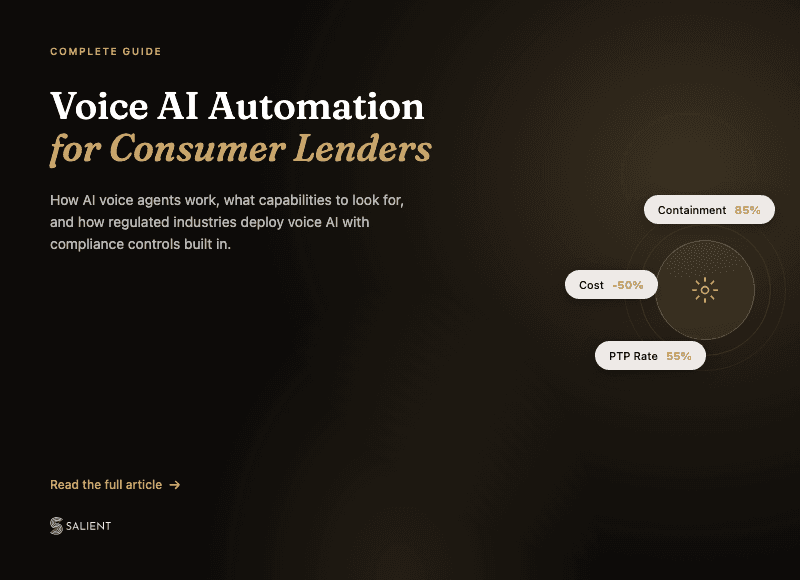
Cost efficiency | 50% reduction in operational costs compared to fully staffed operations |
Recovery performance | 55% promise-to-pay rate with higher right-party contact rates |
Consistency | Every call follows the same compliant process |
How to Deploy AI Voice Agents
Deployment doesn't require a multi-year transformation. Most teams start with a focused pilot and expand from there.
Define Pilot Scope and Guardrails
Start narrow: a single portfolio, a single use case, clearly defined boundaries. Work with risk, compliance, and operations to design something comfortable to show regulators from day one.
Configure Compliance Controls and Policies
Set up disclosures, prohibited phrases, contact windows, escalation rules, and all governance controls before any calls go live. This happens in the platform, not in a separate document.
With Agent Studio, compliance and operations teams can configure and modify agents without engineering dependencies. Build new workflows, adjust guardrails, and update scripts directly in the interface.
Test with Automated Quality Assurance
Run every policy and prompt change through automated tests. Validate behavior across hundreds of simulated scenarios before deployment. Catch issues before they reach callers, not after.
Launch and Measure Outcomes
Deploy to live traffic with clear metrics: containment, handle time, recovery rate, escalation rate. Iterate based on results. Most teams see measurable outcomes within weeks, not months.
Build Compliant AI Voice Agents for Lending Operations
Lenders are deploying AI voice agents today to handle collections, customer service, disputes, and loss mitigation with compliance controls built in from the start.
Salient is purpose-built for this environment. Our agents are configured around the realities of US consumer-lending regulation, integrate with the systems teams already use, and log everything for audit and exam readiness.
Most teams start with a focused pilot: a single portfolio, a single agent, clearly defined guardrails, and measurable outcomes in weeks.
FAQs About Voice AI Automation
Can AI voice agents handle sensitive conversations like hardship or collections calls?
Yes. AI voice agents can be configured with empathy-driven scripts and strict guardrails for difficult conversations. This includes required disclosures, tone guidance, and escalation rules for situations that benefit from human judgment. The key is building these controls into the platform rather than relying on generic AI behavior.
How do lenders prove AI voice agent compliance to regulators and auditors?
Compliant platforms log every interaction: what was said, what action was taken, and the rationale. Teams can export evidence packs for exams and internal audits on demand. This documentation shows exactly how the AI behaved and why.
What happens when an AI voice agent encounters a situation it cannot handle?
The agent follows preconfigured escalation rules to route the call to a human agent. The human agent receives full context from the AI interaction, so the borrower doesn't have to repeat themselves.
Do AI voice agents remember previous conversations with the same borrower?
Platforms with borrower-level memory retain context from prior calls, promises, hardship notes, and account history. Every conversation picks up where the last one left off.
Can AI voice agents execute transactions directly in loan servicing systems?
Yes. Integrated AI voice agents can update records, submit payment instructions, set promises-to-pay, adjust due dates within approved parameters, and write outcomes back to LMS and servicing systems in real time.