Mar 5, 2026
TCPA Consent Management for AI Voice Agents: What Lenders Get Wrong
What lenders get wrong about TCPA consent when deploying AI voice agents — and how to fix it before it becomes a liability.
AI voice agents can place thousands of calls before anyone catches a compliance problem. Under the TCPA, each of those calls carries separate statutory damages of $500–$1,500.
Most lenders know TCPA consent matters. Fewer understand how the rules change when the voice on the call is artificial. This article covers the specific consent mistakes lenders make with AI voice agents, what the law actually requires, and how to build compliant outreach at scale.
Why TCPA compliance gets harder with AI voice
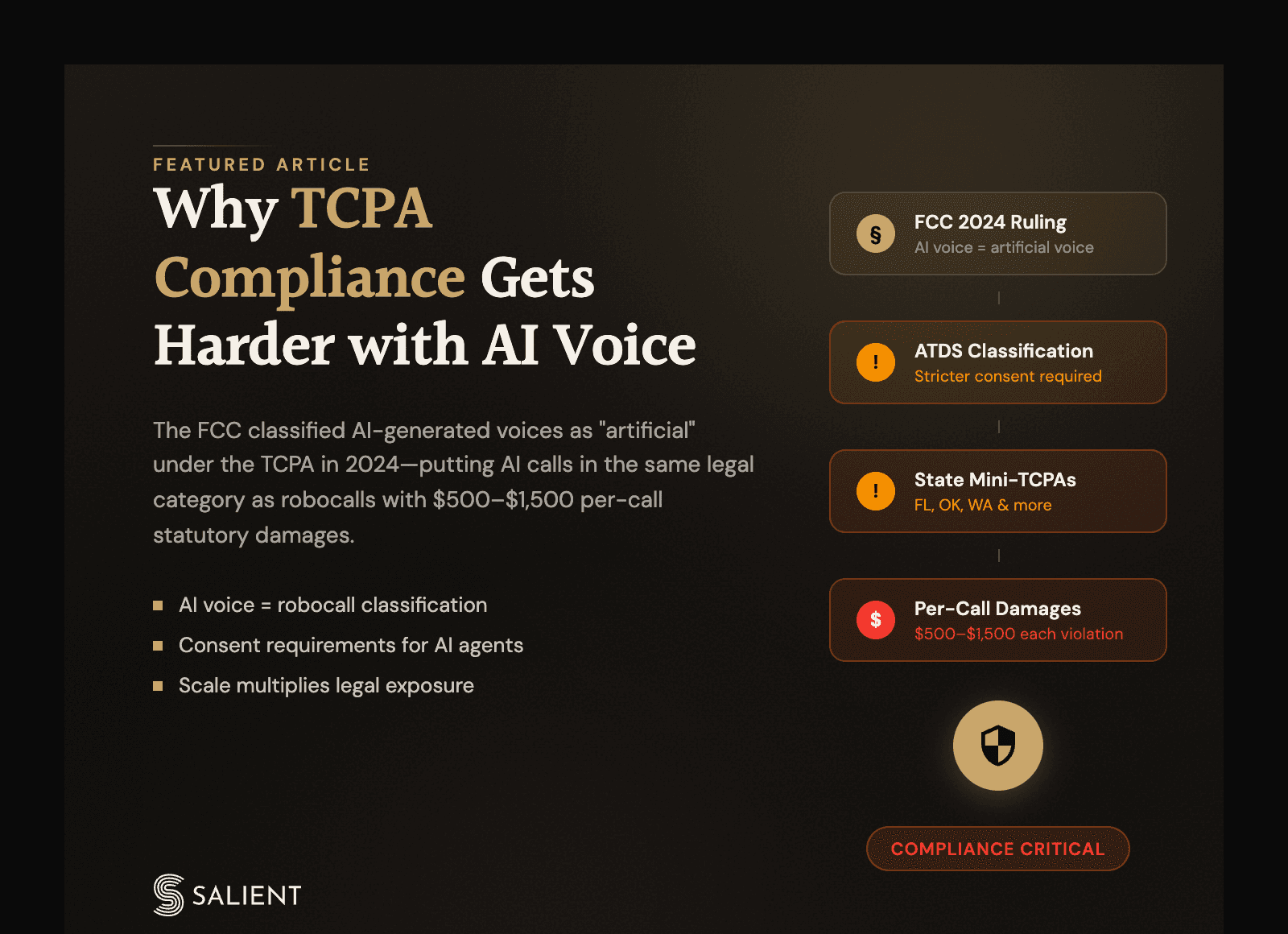
Lenders adopting AI voice agents often assume the same consent rules apply as with human agents. They don't. In February 2024, the FCC classified AI-generated voices as "artificial" under the Telephone Consumer Protection Act. That classification puts AI voice calls in the same legal category as robocalls, with the same $500–$1,500 per-call statutory damages.
The challenge isn't just regulatory. It's operational.
Automated dialing ambiguity: AI systems may qualify as auto-dialers under TCPA definitions, which triggers stricter consent requirements even for non-marketing calls.
Artificial voice classification: AI-generated speech falls under TCPA provisions for prerecorded messages, regardless of how natural the conversation sounds.
Scale of exposure: Each non-compliant call creates a separate statutory damages claim. An AI agent can place thousands of calls before anyone catches a pattern.
The rules didn't change because regulators wanted to slow down innovation. The technology outpaced the original consent frameworks.
TCPA consent mistakes lenders make with AI voice agents
1. Treating legacy consent as AI voice authorization
Consent obtained years ago for human calls or general marketing rarely covers AI-generated voice outreach. "Prior express consent" for informational calls is a lower standard than "prior express written consent" for telemarketing. Legacy permissions often fail to meet either standard for automated calls.
Many lenders assume their existing consent language is broad enough. It usually isn't. A consent form from 2019 that mentions "phone calls" doesn't automatically extend to AI-generated voice in 2025.
2. Failing to document consent at the call level
Lenders often have consent somewhere in their systems but cannot produce call-level evidence showing it was valid at the moment of each specific call. The documentation gap, not the consent gap, creates legal exposure.
When a plaintiff's attorney asks for proof of consent for a specific call on a specific date, "we have it in our LOS somewhere" isn't a defensible answer. The question is whether you can produce a timestamped record linking that borrower's consent to that exact call.
3. Ignoring consent revocation during calls
Borrowers can revoke consent mid-conversation. An AI system that doesn't recognize and honor revocation in real time creates immediate compliance risk.
A borrower saying "stop calling me" during an AI call creates an obligation right then. Many lenders lack processes to capture in-call revocations and update their systems before the next outreach attempt goes out.
4. Missing state mini-TCPA requirements
Federal TCPA compliance is necessary but not sufficient. States like Florida, Oklahoma, and Washington impose stricter rules than federal law.
Florida: Requires written consent for sales calls and limits calling hours beyond federal windows.
Oklahoma: Uses stricter auto-dialer definitions that may capture more AI systems.
Washington: Imposes enhanced consent requirements for certain call types.
A lender compliant with federal rules can still face state-level liability in every jurisdiction where calls are placed.
5. Assuming the AI vendor handles compliance
Many lenders believe their AI voice vendor bears responsibility for TCPA compliance. In practice, the "initiating party"—typically the lender whose name appears in the call—bears primary liability regardless of who provides the technology.
Vendor contracts may include indemnification clauses, but indemnification doesn't prevent lawsuits. It only affects who pays after the fact.
What the TCPA requires for artificial and prerecorded voice
Prior express consent vs. prior express written consent
The TCPA distinguishes between two consent standards. The difference matters for AI voice deployment.
Consent Type | When Required | How Obtained | Revocability |
|---|---|---|---|
Prior Express Consent | Informational calls | Oral or written | Anytime, any reasonable means |
Prior Express Written Consent | Telemarketing calls | Signed written agreement | Anytime, any reasonable means |
Collections calls often fall into a gray area. A payment reminder might be informational. A call offering a settlement discount might be telemarketing. The classification affects which consent standard applies.
How AI voice systems may qualify as an ATDS
An ATDS, or Automatic Telephone Dialing System, is a key legal term in the TCPA. Courts continue to debate whether modern AI voice platforms meet the ATDS criteria based on their capacity to store or produce and then dial numbers.
The Supreme Court's 2021 Facebook v. Duguid decision narrowed the ATDS definition, but it didn't eliminate it. AI platforms that generate or randomly dial numbers, rather than calling from a fixed list, may still qualify.
Time-of-day and contact frequency restrictions
Federal TCPA rules restrict calls to between 8 a.m. and 9 p.m. in the recipient's time zone. While specific frequency caps aren't federally mandated, regulators and courts enforce "reasonableness" standards.
An AI agent that calls a borrower twelve times in a week might be technically compliant with timing rules while still creating harassment liability under state law or UDAAP standards.
Who bears liability for AI voice TCPA violations
Lender liability as the initiating party
The party "on whose behalf" the call is made is primarily liable under the TCPA. If the lender's name appears in the call, the lender is the responsible party.
This holds true even when a third-party vendor operates the AI platform, manages the dialing infrastructure, and handles the call flow.
Platform liability under vicarious theories
AI vendors can face secondary liability under vicarious liability or agency theories. However, secondary liability doesn't reduce the lender's exposure. Both parties can be named in the same lawsuit.
Plaintiffs' attorneys typically sue everyone in the chain. The question of who ultimately pays gets sorted out later.
How contracts allocate TCPA risk between parties
Vendor contracts often include indemnification clauses that shift financial responsibility. Indemnification matters for internal cost allocation but doesn't affect who plaintiffs can sue.
A lender with strong contractual protections can still spend months in litigation before those protections become relevant.
Why scaling AI voice outreach multiplies legal risk
The math of TCPA exposure changes dramatically at scale. A human agent might make dozens of problematic calls before a pattern emerges. An AI agent can make thousands in the same timeframe.
Statutory damages: Each violation carries separate damages of $500–$1,500, creating massive aggregate exposure at volume.
Class action exposure: Patterns of non-compliant calls are prime targets for class certification.
Speed of harm: AI operates continuously, compounding violations faster than manual review can catch.
A single misconfigured consent check that affects 1% of calls becomes significant liability when the AI places 50,000 calls per month.
What recent court rulings mean for AI voice consent
Fifth Circuit on written consent requirements
The Fifth Circuit's Insurance Marketing Coalition ruling questioned the FCC's specific written consent requirements. Some lenders interpreted the ruling as eliminating consent requirements entirely.
That interpretation is wrong. The ruling affects the type of consent required in certain circumstances, not whether consent is required at all.
Why consent still matters after McKesson and McLaughlin
Despite rulings that have narrowed ATDS definitions or questioned specific consent requirements, using AI to make voice calls without any consent remains illegal under the TCPA's plain text.
The FCC's February 2024 declaratory ruling explicitly classified AI-generated voices as "artificial" under the TCPA. That classification hasn't been overturned.
TCPA compliance requirements beyond consent
Do-not-call list and opt-out compliance
AI systems check both the national Do-Not-Call registry and the lender's internal DNC list before every call. A valid consent doesn't override a DNC registration.
The national registry updates monthly. Internal lists can change hourly. Real-time checking matters.
Called-party identification and verification
Compliance requires reaching the intended recipient, not just dialing a number. Reassigned numbers create liability even when the lender had valid consent from the previous owner.
The FCC maintains a Reassigned Numbers Database specifically to address reassigned number risk. Checking the database before outreach reduces wrong-party contact exposure.
Disclosure and mini-Miranda requirements for collections
Collections calls require specific disclosures under the Fair Debt Collection Practices Act. AI agents handling collections deliver "mini-Miranda" disclosures correctly and consistently on every applicable call.
A natural-sounding AI conversation that omits required disclosures creates FDCPA liability on top of any TCPA exposure.
How to manage TCPA consent for AI voice agents
1. Audit existing consent records before deployment
Before launching an AI voice campaign, lenders benefit from reviewing existing consent language, timestamps, and scope. The goal is to identify gaps between what current consent covers and what the AI will actually do.
Many lenders discover their consent language predates AI voice technology entirely.
2. Configure real-time consent validation
AI systems can verify consent status at the moment of call initiation rather than relying on batch checks from hours or days earlier. Consent can be revoked at any time, so point-in-time validation matters.
A borrower who revoked consent at 2 p.m. shouldn't receive an AI call at 3 p.m. because the system only checks consent daily.
3. Enforce contact windows and frequency caps automatically
AI platforms can automatically block calls outside permitted hours and enforce per-borrower contact frequency limits without manual intervention.
Automatic enforcement removes human error from timing compliance. The system simply won't place a call that violates configured rules.
4. Log every call attempt with consent status and outcome
Proving compliance requires documentation showing consent status at the time of each call, the call's outcome, any revocation that occurred, and which disclosures were delivered.
Platforms like Salient's Taylor agent log this information automatically, creating audit-ready records for every interaction.
5. Build processes for real-time consent revocation
When a borrower says "stop calling" during an AI call, the system recognizes the request, honors it immediately, and updates records to block future calls.
Real-time revocation handling isn't just a technical capability. It's a workflow that connects the AI agent to the lender's systems of record.
How compliance-first AI voice platforms reduce TCPA exposure
Compliance-built platforms embed TCPA controls into the system architecture rather than bolting them on afterward. Salient's Taylor agent includes configurable contact windows, frequency caps, disclosure delivery, and call-level logging as core features.
Configurable contact windows: Automatically enforce state and federal calling hours based on borrower location.
Consent validation at call time: Check consent status before each call initiates.
Real-time revocation handling: Recognize and honor opt-outs during live calls.
Audit-ready logging: Document consent status, disclosures, and outcomes for every interaction.
The difference isn't just feature availability. It's whether compliance is the foundation or an afterthought.
Book a demo to see how compliance-first AI voice works in practice.
FAQs about TCPA consent for AI voice agents
Is it illegal to cold call with an AI voice agent?
Yes. Using AI-generated voice to call consumers without prior consent violates the TCPA. Cold calls by definition lack the required consent, making them illegal regardless of how natural the AI sounds.
What penalties can lenders face for AI voice TCPA violations?
The TCPA provides for statutory damages of $500–$1,500 per violation. Because AI systems can place high call volumes quickly, aggregate exposure in class actions can reach millions of dollars.
How do state mini-TCPA laws affect AI voice compliance?
Several states impose stricter consent, timing, or disclosure requirements than the federal TCPA. Lenders placing calls into multiple states face a patchwork of requirements that federal compliance alone doesn't satisfy.
Can borrowers revoke TCPA consent during an AI voice call?
Yes. Borrowers can revoke consent at any time through any reasonable means, including verbally during a call. The AI system recognizes and honors that revocation immediately.
Does TCPA apply differently to inbound versus outbound AI voice calls?
TCPA restrictions primarily target outbound calls initiated by the lender. Inbound calls where the borrower initiates contact generally don't require the same prior consent, though other disclosure rules and UDAAP considerations still apply.