Mar 16, 2026
Integrating AI into Existing Loan Servicing Platforms: A Technical Roadmap
A step-by-step guide to connecting AI to your LMS, contact center, and payment systems—without replacing infrastructure or creating compliance risk.
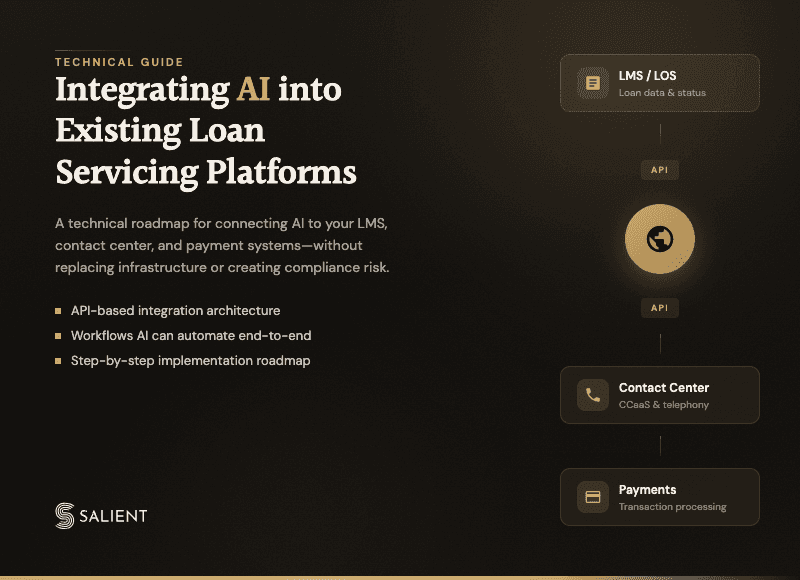
Most lenders aren't asking whether AI can improve loan servicing. They're asking how to connect it to the systems they already run without creating compliance risk or ripping out infrastructure.
The answer lies in integration, not replacement. Modern AI platforms connect via APIs to existing LMS, contact center, and payment systems—reading borrower data, taking action, and writing outcomes back. This guide covers the core technologies, specific workflows AI can automate, integration architecture, compliance requirements, and a step-by-step implementation roadmap for regulated lenders.
What AI integration means for loan servicing platforms
Integrating AI into existing loan servicing platforms allows lenders to automate routine tasks, reduce operational costs by 30–50%, and provide borrowers with 24/7 support. Rather than replacing legacy systems, modern AI connects via APIs to your Loan Management System (LMS), contact center, and payment providers.
Think of it as an integration layer. The AI reads borrower data from your existing systems, takes action, and writes outcomes back. You're not building new infrastructure. You're embedding AI into workflows you already run.
Why loan servicers are integrating AI now
The pressure to adopt AI isn't coming from technology trends. It's coming from operational realities that compound over time.
Fragmented borrower data across servicing systems
Borrower information typically lives in disconnected places: the LMS, telephony platform, payment processor. Agents toggle between screens. Handle times stretch. Borrowers repeat the same information on every call.
Rising costs from manual call handling
Staffing live agents for routine inquiries like balance checks, payment dates, and extension requests creates significant cost burden. High-volume, low-complexity calls consume expensive human capacity that could go toward more complex work.
Compliance risk from inconsistent interactions
Human variability introduces compliance gaps. Missed disclosures. Inconsistent scripting. Undocumented conversations. With increasing CFPB and state examiner scrutiny, gaps like these create real exposure.
Limited scalability in contact center operations
Fixed staffing models struggle with call volume spikes during delinquency seasons or around payment due dates. AI offers always-on capacity to handle surges without adding headcount.
Core AI technologies that power loan servicing automation
A few foundational technologies make loan servicing automation possible. Understanding what each does helps clarify where they fit.
Natural language processing for borrower conversations
Natural Language Processing, or NLP, enables AI to understand and respond to borrower intent across voice, text, and email. NLP powers conversational dialogue rather than rigid, menu-driven scripts.
Machine learning for predictive analytics
Machine Learning, or ML, learns from historical data to predict outcomes like likelihood of payment, default risk, or optimal contact timing. Lenders use ML to inform prioritization and outreach strategy.
AI agents that execute full back-office workflows
Unlike chatbots that only answer questions, AI agents take action. They update systems, submit payments, set promises-to-pay, and route escalations. Purpose-built platforms like Salient's Taylor agent handle regulated workflows end-to-end, while generic conversational AI lacks the lending-specific controls examiners expect.
Loan servicing workflows AI can automate end-to-end
AI handles specific workflows from initial contact through final system update. Not just the conversation, but the operational work behind it.
Collections and promise-to-pay management
AI manages outbound and inbound collections calls, negotiates payment arrangements within configured guardrails, sets promises, and follows up automatically. All outcomes write back to the LMS.
Payment processing and extension requests
AI processes payments over phone or web, explains payoff amounts, and grants extensions within policy limits. Routine requests resolve without human handoff.
Dispute intake and resolution
AI gathers dispute details, checks against internal rules, documents the interaction, updates servicing systems, and routes complex cases for manual review.
Hardship conversations
AI handles sensitive hardship discussions using borrower-level memory, which means context from prior calls rather than cold scripts. The AI recognizes situational characteristics like job loss or medical events to guide conversations appropriately.
Total-loss claim processing
AI manages total-loss claims from first notice through final settlement: gathering documentation, checking coverage, updating claim status, and communicating with borrowers throughout.
How to connect AI to your LMS, contact center, and payment systems
Technical integration happens via APIs and pre-built connectors. The AI plugs into your environment without replacing core systems.
Integration Point | What AI Reads | What AI Writes Back |
|---|---|---|
LMS/Servicing System | Loan data, payment history, account status | Promises, notes, status updates |
CCaaS/Telephony | Call routing, queue data | Call logs, disposition codes |
Payment Provider | Transaction status | Payment instructions, confirmations |
Integrating with loan management systems
AI connects to common LMS platforms to read borrower data like balances, payment history, and account status. Then it writes actions back: promises, notes, status updates.
Connecting to CCaaS and telephony platforms
AI plugs directly into existing contact center infrastructure to handle calls, route escalations, and log interaction details. No telephony provider change required.
Enabling borrower-level memory across channels
A key capability is borrower-level memory. The AI retains context from all prior calls, texts, emails, promises, and hardship notes. Every new interaction is informed by history, which reduces repeated questions and improves outcomes.
Compliance and regulatory requirements for AI in loan servicing
For regulated lenders, compliance isn't a feature. It's the central concern. A compliance-first approach separates purpose-built platforms from generic solutions.
CFPB, OCC, FDIC, NCUA, and state regulatory expectations
Key regulators focus on fairness, transparency, consumer protection, and third-party risk management. Lenders demonstrate that AI-driven decisions are explainable and auditable.
FDCPA contact rules and required disclosures
AI enforces FDCPA constraints automatically:
Contact windows: Calls only during approved hours
Frequency caps: Limits on how often borrowers are contacted
Required disclosures: Mini-Miranda delivered consistently
Fair lending and bias prevention
To meet Fair Lending requirements under ECOA, AI models undergo testing for disparate impact. All decisions remain explainable. Generic platforms often lack the lending-specific bias controls examiners expect.
Audit trails and evidence packs
AI generates complete, exportable logs of every interaction. What was said, what was done, and why. Evidence packs satisfy examiner requests and internal audit requirements.
Tip: Look for platforms that run automated compliance tests on every policy or prompt change before deployment. Catching violations in testing is far better than catching them in production.
Step-by-step implementation roadmap
Here's a practical sequence for implementing AI in loan servicing operations.
1. Assess current systems and define integration requirements
Start by inventorying your existing LMS, CCaaS, and payment systems. Identify data sources, check API availability, and document security requirements.
2. Select target workflows and define scope
Start narrow. Choose one high-impact workflow, like inbound collections, or a single portfolio segment. Define success criteria upfront.
3. Configure compliance guardrails and policies
Set the rules of engagement: contact windows, disclosure scripts, escalation triggers, prohibited phrases. Base configuration on your regulatory requirements and internal policies.
4. Run automated testing and validation
Test AI behavior against configured compliance rules and edge cases before live deployment. Catch policy violations in simulation, not production.
5. Deploy pilot with a single portfolio
Launch with a clearly scoped pilot: single portfolio, defined guardrails, measurable outcomes. Involve risk, compliance, and operations leaders in the design.
6. Monitor outcomes and scale
Track performance via dashboards showing calls handled, containment rates, and escalations. Expand to additional workflows and portfolios based on results.
Common AI integration challenges and how to address them
Real-world obstacles are predictable. Planning for them accelerates deployment.
Data quality issues: Legacy systems may have incomplete or inconsistent data. Choose platforms that normalize data at ingestion and flag gaps for remediation.
Staff adoption: Operations teams may resist AI. Involve frontline leaders early and demonstrate how AI handles routine work, freeing agents for complex cases.
Vendor lock-in: Some vendors require proprietary infrastructure. Select platforms designed to integrate with existing systems and allow policy control without vendor dependency.
Human oversight: AI cannot handle every scenario. Configure escalation rules that route complex hardship cases and regulatory-sensitive situations to human agents automatically.
Measuring ROI and operational outcomes
Define and track key metrics to evaluate success.
Cost per contact: How AI reduces the average cost of handling routine interactions compared to live agents.
Collections recovery rates: Whether AI-powered outreach improves right-party contact and promise-to-pay follow-through.
Containment rate: The percentage of interactions fully resolved by AI without human escalation. Higher containment means more efficient automation.
Compliance incident reduction: Whether AI reduces errors like missed disclosures or out-of-window contact attempts compared to human-only operations.
How to launch a compliance-ready AI pilot
The most effective starting point is a focused pilot: single portfolio, one AI agent, clearly defined guardrails, measurable outcomes in weeks. Work directly with risk, compliance, and operations leaders to design something teams would be comfortable showing to regulators.
Book a demo to explore how Salient's purpose-built AI agents integrate with your existing loan servicing platform.
FAQs about integrating AI into loan servicing platforms
How long does it typically take to integrate AI into an existing loan servicing platform?
Most lenders launch a focused pilot in weeks, not months, by starting with a single portfolio and one target workflow rather than attempting full-scale deployment.
What data access does an AI platform need from a loan management system?
AI requires read access to borrower account data, payment history, and loan status, plus write access to record promises, notes, and payment instructions.
Can AI handle complex hardship cases involving unique situational characteristics?
AI uses borrower-level memory to personalize hardship conversations, but complex cases route to human agents via pre-configured escalation rules.
How do generic AI agents compare to purpose-built loan servicing platforms?
Generic conversational AI serves broad use cases, while purpose-built platforms focus on regulated lending workflows with compliance guardrails designed for CFPB and state examiner scrutiny.
How can lenders explain AI decisions to regulators during an examination?
Compliant AI platforms log every action, decision, and rationale, then generate exportable evidence packs documenting what was said, what was done, and why.