Feb 26, 2026
How AI Outbound Calling Agents Work in 2026
A practical guide to how AI outbound calling works, where it fits in lending operations, and how to deploy it.
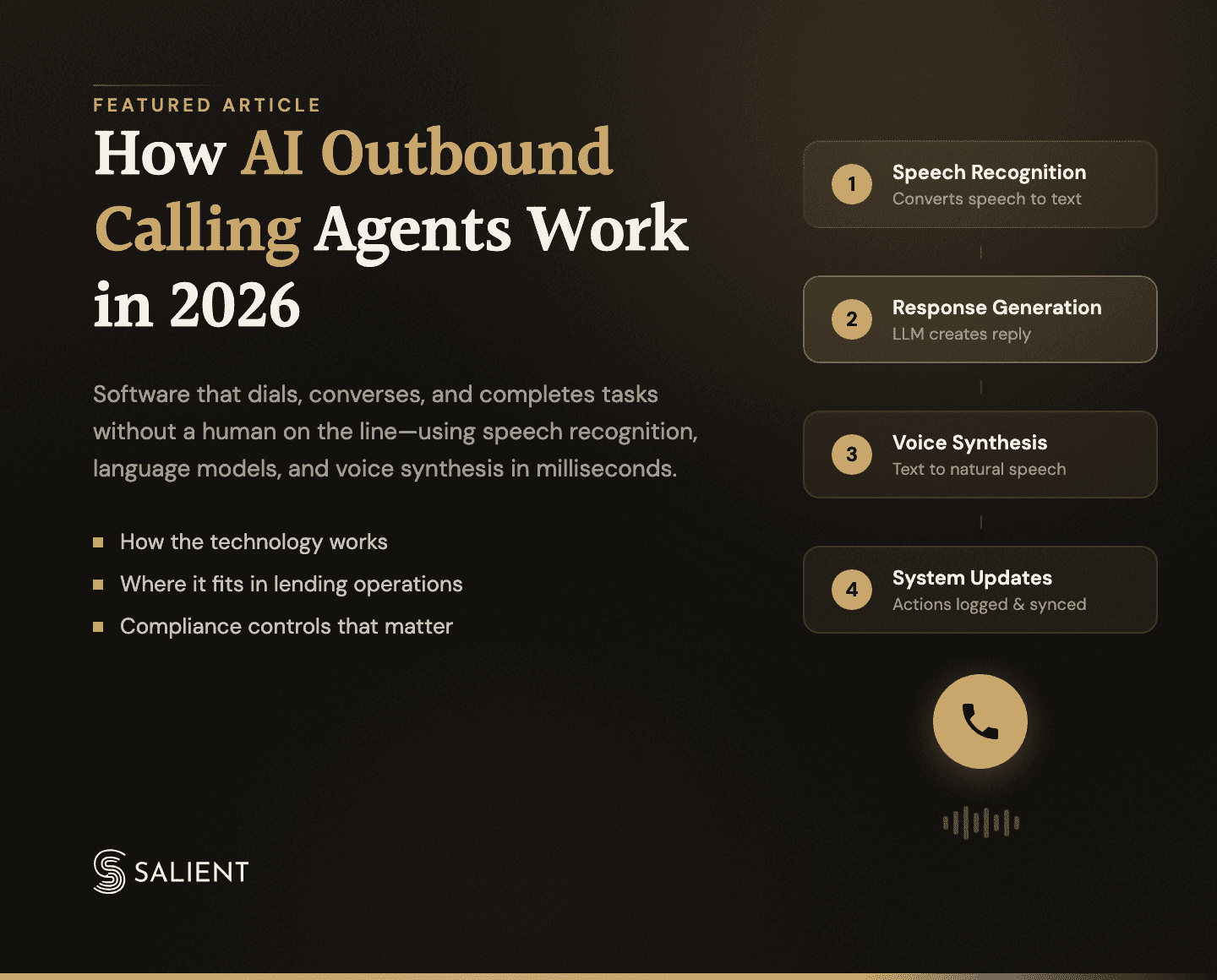
AI outbound calling agents are systems that dial phone numbers, hold real-time conversations, and complete tasks without a human on the line. They use speech recognition to understand what someone says, generate responses using language models, and speak back using voice synthesis—all in milliseconds.
This guide covers how the technology actually works, where it fits in lending operations, and what compliance controls matter for regulated deployment.
What is an AI outbound calling agent
An AI outbound calling agent is software that dials phone numbers, holds real-time conversations, and completes tasks without a human on the line. The agent uses speech recognition to understand what someone says, generates responses using a language model, and speaks back using voice synthesis. All of this happens in milliseconds, creating a conversation that flows naturally.
This is different from an autodialer, which simply connects calls to human agents. It's also different from an IVR system, which routes callers through menu options. An AI outbound agent handles the entire interaction from start to finish.
Three characteristics define an AI outbound calling agent:
Autonomous initiation: The agent dials contacts based on a list, schedule, or trigger event without human involvement
Natural conversation: The agent understands speech and responds dynamically rather than playing pre-recorded messages
Task completion: The agent takes actions during or after the call, like updating a CRM, scheduling a follow-up, or processing a payment
Can AI agents make outbound calls
Yes. AI agents can and do make outbound calls at scale today. The technology works reliably across industries including healthcare, financial services, and retail.
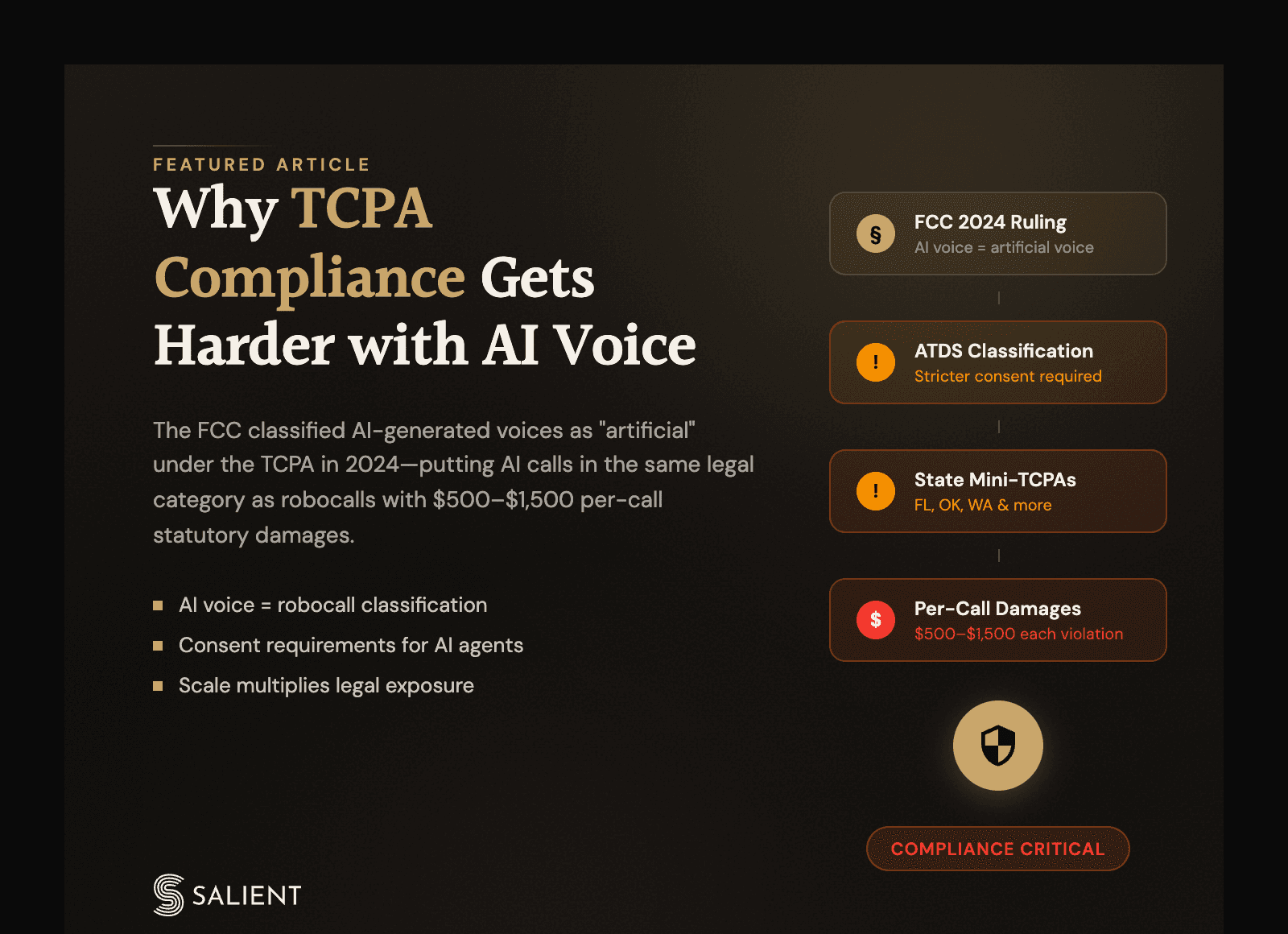
The real question is whether a specific deployment meets legal requirements. Under the Telephone Consumer Protection Act (TCPA), AI-generated voices count as "artificial," which means prior express consent is typically required before placing the call. For collections, FDCPA rules add requirements around disclosures, contact frequency, and honoring opt-out requests.
So the capability exists. Compliance determines how and when you can use it.
How AI outbound callers process calls
Understanding what happens during a call helps clarify why AI agents behave the way they do. Here's the sequence from dial to completion.
Speech recognition and intent detection
When someone answers, the AI agent converts their speech to text using automatic speech recognition, or ASR. This conversion happens continuously throughout the call, not just at the start.
At the same time, the agent analyzes what the person means. If a borrower says "I thought I already took care of that," the agent recognizes this as a potential dispute or payment question rather than a simple statement. Intent detection allows the agent to respond appropriately instead of following a rigid script.
Real-time response generation
Once the agent understands intent, it generates a reply using a large language model. The response draws on conversation context, account data, and configured guidelines.
This dynamic generation is what separates AI agents from older automation. The agent can handle objections, answer unexpected questions, and adapt when the conversation takes a turn. There's no decision tree to fall off of.
Voice synthesis and natural delivery
The generated text converts to speech through text-to-speech synthesis, or TTS. Modern TTS produces natural-sounding speech with appropriate pacing and tone.
Some systems adjust delivery based on context. A payment confirmation might sound slightly more formal than a scheduling conversation. Small adjustments like this make the interaction feel less robotic.
System updates and action logging
After the call ends, the agent writes outcomes back to connected systems automatically. This might mean updating a loan management system with a promise-to-pay, logging call notes in a CRM, or triggering a follow-up task.
Every interaction is also logged in detail: what was said, what actions were taken, and why. For regulated industries, this audit trail provides the documentation that examiners expect to see.
Why lenders use AI for outbound calls
Lenders aren't adopting AI outbound calling because it's new. They're adopting it because human-only teams face structural limitations that AI can address.
Manual outbound bottlenecks
A human agent can realistically complete 40 to 60 meaningful outbound calls per day. For a lender with tens of thousands of accounts in early-stage collections, reaching every borrower within a billing cycle isn't possible without significant headcount.
AI agents can conduct hundreds of simultaneous calls. This changes the math from "who can we reach" to "who do we prioritize for human follow-up."
Limited contact windows and coverage
Regulations and internal policies restrict when outbound calls can happen. Human teams have perhaps 8 to 10 productive hours per day within those windows.
AI agents maximize every available minute. There's no ramp-up time, no breaks, no end-of-shift slowdown. The result is higher contact rates within the same compliant timeframes.
Compliance and consistency gaps
Human agents vary. Even well-trained teams deliver disclosures differently, document inconsistently, and occasionally say things that create risk.
AI agents deliver the same disclosures, follow the same scripts, and document every interaction identically. This consistency reduces compliance risk and simplifies exam preparation.
Common use cases for outbound AI calling agents
AI outbound calling fits best where conversations are high-volume, repeatable, and benefit from consistency.
Collections and payment reminders
Early-stage collections is the most common starting point. AI agents handle payment due reminders, past-due notifications, and promise-to-pay follow-ups. They can negotiate arrangements within configured parameters and process payments during the call.
Verification and onboarding calls
New account verification, including identity confirmation and loan detail review, follows predictable patterns. AI agents handle these calls efficiently while following multi-step verification protocols. Welcome calls that guide borrowers through autopay enrollment also fit well here.
Customer service follow-ups
Answers ongoing borrower questions and manages payments, extensions, hardship screening, and account updates in real time — logging outcomes and syncing data back to your LMS and CRM automatically.
AI outbound agents vs traditional dialers
Traditional dialers and AI outbound agents solve different problems. A dialer automates the dialing process, but a human still handles every conversation. An AI agent handles both.
Capability | Traditional dialer | AI outbound agent |
|---|---|---|
Conversation handling | Transfers to human | Handles autonomously |
Script adherence | Varies by agent | Consistent every call |
System updates | Manual entry | Automatic write-back |
Compliance logging | Partial | Full interaction record |
Scalability | Limited by headcount | Parallel call capacity |
The distinction matters for capacity planning. Dialers increase efficiency per human agent. AI agents reduce the number of calls that require human agents at all.
How to use AI for outbound calling
Deploying AI outbound calling follows a predictable path. Here's what implementation typically looks like.
1. Define goals and configure guardrails
Start by identifying the use case: early-stage collections, verification, payment reminders. Define success metrics like contact rate, promise-to-pay rate, or containment rate.
Then configure compliance rules: contact windows, frequency caps, required disclosures, and escalation triggers. These guardrails determine what the agent can and cannot do.
2. Integrate with existing systems
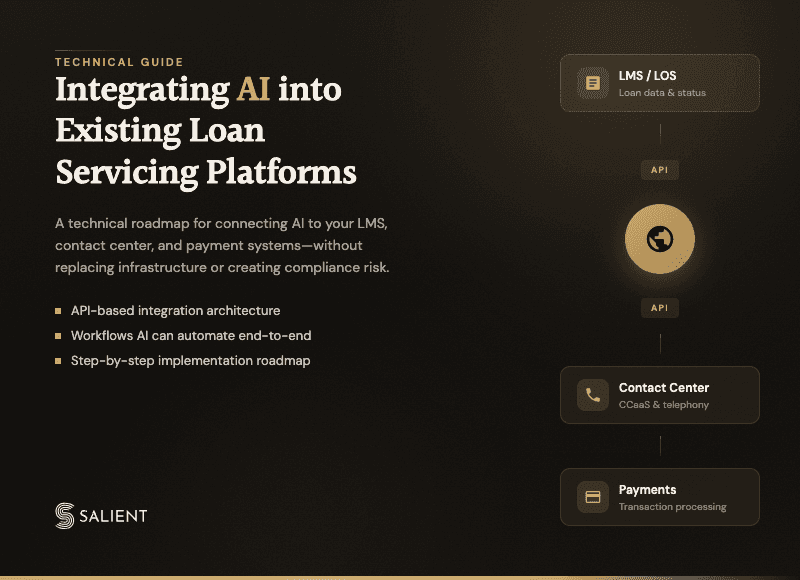
The agent connects to your loan management system, CRM, contact center platform, and payment providers. This integration allows the agent to pull borrower data before calls and write outcomes back automatically.
Purpose-built platforms connect to existing infrastructure without requiring replacement. Pilots can launch without disrupting core operations.
3. Test conversations before launch
Before any live calls, run the agent through simulated borrower scenarios. Test edge cases: disputes, hardship claims, cease-and-desist requests, unexpected questions.
Automated testing validates that compliance rules work as configured and conversations meet quality standards.
4. Deploy and monitor performance
Launch with a focused pilot, typically a single portfolio segment with clear boundaries. Monitor containment rates, escalation patterns, and borrower outcomes. Iterate based on results before expanding scope.
Compliance controls for outbound AI call agents
For regulated lenders, compliance isn't a feature. It's the foundation that determines whether AI can be deployed at all.
Contact windows and frequency caps
AI agents enforce contact windows automatically. If regulations or policy prohibit calling before 8am or after 9pm local time, the agent won't dial during those hours.
Frequency caps work the same way. If policy limits contact attempts to three per week, the system tracks attempts and stops automatically. Human error is removed from the equation.
Required disclosures and prohibited phrases
Certain disclosures are legally required. Mini-Miranda in collections, for example. AI agents deliver these consistently on every applicable call, using the exact language compliance teams approve.
Prohibited phrases, including language that creates UDAAP risk, are configured as guardrails. The agent won't say them.
Audit logging and evidence export
Every interaction is logged: the full transcript, actions taken, system updates, and the reasoning behind decisions.
When regulators or internal audit request documentation, evidence exports are available immediately. There's no reconstruction from partial records weeks later.
What to look for in an outbound AI voice agent
Not all AI outbound platforms are equivalent. Here's what matters when evaluating options.
Built-in compliance and governance
Look for configurable contact rules and disclosure scripts, automated policy testing before deployment, full audit trails with rationale logging, and evidence export for regulators and internal audit.
Deep system integration
Look for native connectors to LMS, LOS, CCaaS, and payment providers. Two-way data sync, meaning the agent can read borrower data and write outcomes back, eliminates manual entry. Integration without infrastructure replacement makes pilots feasible.
Borrower-level memory and context
Look for persistent memory across interactions, including prior calls, promises, and disputes. Context sharing across channels like voice, SMS, and email allows personalized conversations without repeated questions.
Generic AI platforms often lack these capabilities. Purpose-built solutions for regulated lending, like Salient, design around these requirements from the start.
Why regulated lenders choose purpose-built AI outbound agents
Generic contact center AI can make calls and hold conversations. What it typically can't do is operate within the specific constraints of consumer lending regulation.
Purpose-built platforms are designed around FDCPA, TCPA, UDAAP, and state-level requirements. Compliance controls are system-level defaults, not optional configurations. Audit trails are comprehensive by design.
For lenders evaluating AI outbound calling, the question isn't whether the technology works. It does. The question is whether it works within your regulatory reality.
Most teams start with a focused pilot: a single portfolio, a single use case, clearly defined guardrails, and measurable outcomes in weeks.
FAQs about AI outbound calling agents
Is AI outbound sales calling illegal?
AI outbound calling is legal when it complies with TCPA consent requirements, state regulations, and industry-specific rules. For collections, FDCPA requirements also apply. Legality depends on proper disclosure and consent, not the technology itself.
How do AI outbound agents handle unexpected questions or objections?
AI outbound agents use large language models to generate contextual responses in real-time. When a question falls outside configured guardrails or requires human judgment, the agent follows escalation rules to transfer the call or schedule a callback.
What happens when an AI outbound agent cannot resolve a call?
The agent follows pre-configured escalation rules, transferring to a live agent, scheduling a callback, or logging the interaction for human follow-up. The reason for handoff is documented automatically.
Can AI outbound calling agents integrate with loan servicing systems?
Yes. Purpose-built AI outbound agents connect to LMS, LOS, CCaaS, and payment providers to read borrower data before calls and write outcomes back automatically.