Feb 24, 2026
The Collections Team Transformation: What to Expect After AI Implementation
AI doesn't replace your collections team — it transforms what they spend their time on.
Most collections leaders considering AI have the same first question: what actually happens to my team?
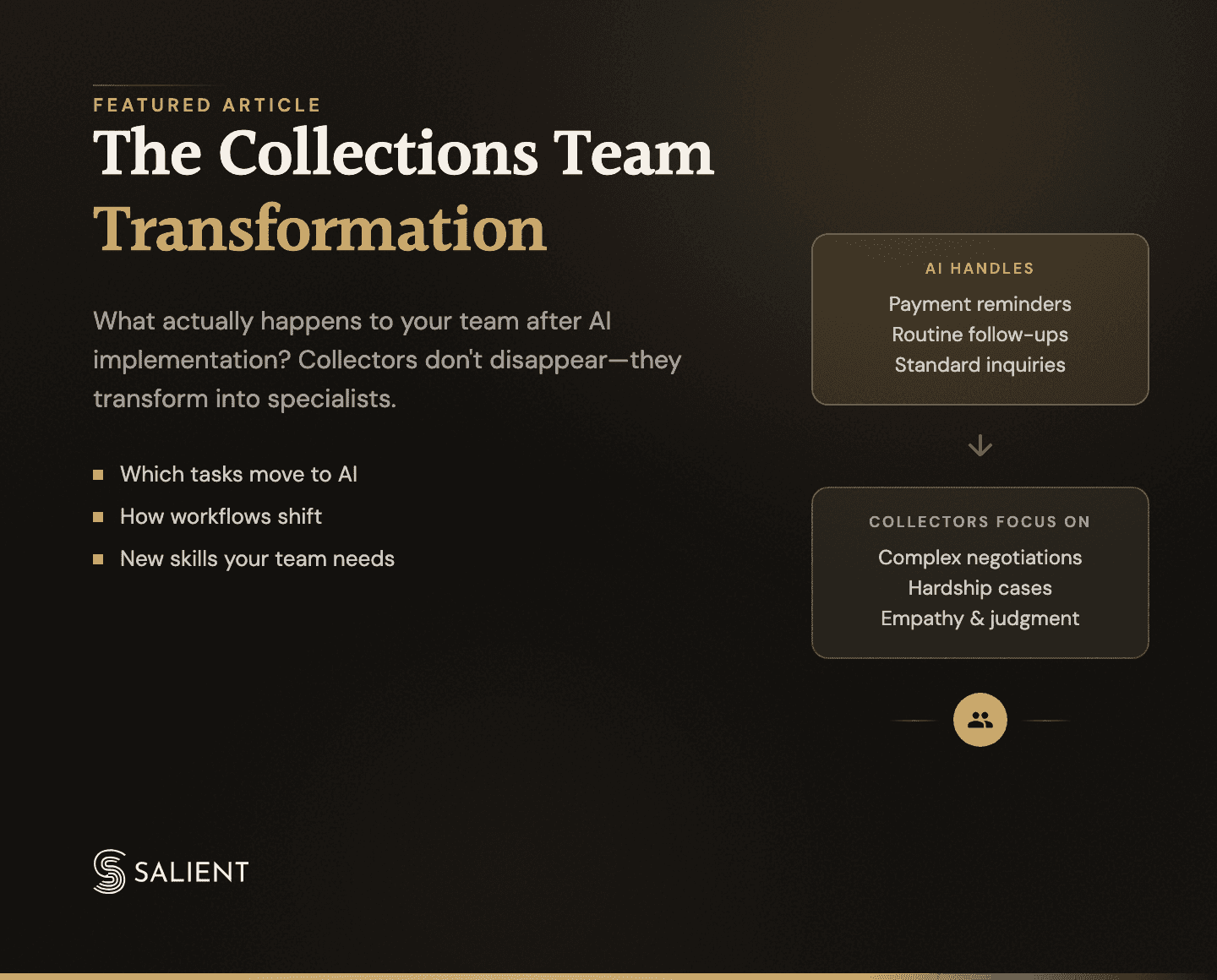
The short answer is that your collectors don't disappear—they transform. AI handles the repetitive volume while humans focus on the conversations that require judgment, empathy, and negotiation skills. This article walks through exactly what changes: which tasks move to AI, which stay with collectors, how workflows shift, and what new skills your team will need after deployment.
What changes for collections teams after AI deployment
When you deploy AI in collections, your team shifts from a manual, high-volume operation to a more strategic function. AI handles the repetitive work—payment reminders, routine follow-ups, standard inquiries—while human collectors focus on complex negotiations and sensitive cases. The outcome is typically higher productivity per collector, improved recovery rates, and more consistent borrower interactions.
This isn't about reducing headcount. It's about changing what collectors actually do with their time.
Day one looks different. Collectors notice fewer routine calls landing on their desks, more context available before every conversation, and less time spent on documentation. The calls that do reach them tend to be escalations, hardship situations, or disputes that require real judgment.
Will AI replace your debt collectors
This is the first question most collectors ask. The answer: no, but roles change significantly.
AI takes over the repetitive contact attempts and routine inquiries that fill most of a collector's day. What remains for humans is the work that requires judgment—hardship negotiations, escalated disputes, borrowers requesting supervisors, and situations where empathy matters more than efficiency.
Not because AI can't handle nuance. Because borrowers in financial distress benefit from human judgment, and regulators expect it.
Teams that deploy AI often find collectors report higher job satisfaction afterward. The monotonous work disappears, and what's left feels more meaningful. Turnover tends to decrease when collectors feel like specialists rather than dialers.
Which tasks move to AI and which stay with collectors
The clearest way to understand the transformation is to look at specific tasks. Some move entirely to AI, some stay with humans, and some become collaborative.
Task Type | Handled By | Rationale |
|---|---|---|
Routine payment reminders | AI | High volume, scripted, time-sensitive |
Promise-to-pay setup | AI | Rule-based within policy guardrails |
Balance and due date inquiries | AI | Straightforward lookups |
Hardship negotiations | Human | Requires empathy and judgment |
Escalated disputes | Human | Complex documentation and decision-making |
Payment processing | Both | AI initiates, human reviews exceptions |
Tasks AI handles autonomously
AI works well for high-volume, predictable interactions. Outbound reminder calls, payment confirmations, standard disclosures, and balance inquiries all fall into this category. The AI delivers Mini-Miranda statements, handles state-specific notices, and answers routine questions without collector involvement.
Tasks that remain with human collectors
Some conversations require judgment that AI cannot replicate. Hardship evaluations where borrowers explain financial circumstances, legal escalations involving attorney representation, complex disputes requiring documentation review, and any situation where a borrower explicitly requests a supervisor—all of these stay with humans.
These are higher-value activities. Collectors who handle them well directly impact recovery rates and borrower experience.
Tasks where AI and collectors collaborate in real time
The most effective deployments treat AI and collectors as a team. AI gathers context, surfaces account history, and routes complex cases to collectors with full borrower memory already attached.
When a collector picks up an escalated call, they see what the AI already discussed, what promises were made, and what the borrower's history looks like. No repeated questions. No starting from scratch. Platforms with borrower-level memory make this handoff seamless, so collectors can focus on resolution rather than information gathering.
How collections workflows transform with AI-powered automation
The day-to-day sequence of collections work changes substantially after AI deployment. Here's what that looks like across common workflow types.
Inbound call and message handling
AI answers first. For routine requests—balance inquiries, payment dates, payoff quotes—the AI resolves the interaction without human involvement. When the conversation requires judgment or the borrower requests a person, the AI routes the call to a collector with full context already captured.
Collectors no longer spend time on calls that could have been self-service.
Outbound contact campaigns
AI manages contact frequency, optimal timing, and channel selection across voice, SMS, and email. It respects contact windows, enforces frequency caps, and tracks which channels work best for each borrower. Collectors review exceptions and high-priority accounts rather than manually dialing through lists.
Payment and promise-to-pay processing
AI captures payment instructions, sets promises within policy guardrails, and writes outcomes back to loan systems automatically. Collectors handle modifications that fall outside standard parameters—extended arrangements, unusual hardship situations, or policy exceptions.
Escalation routing for complex cases
Intelligent routing identifies when to escalate based on borrower sentiment, account flags, or regulatory requirements. The collector receives the full interaction history, so they understand the situation before saying hello.
What happens to productivity and recovery rates
The productivity shift is measurable. Collectors handle fewer total interactions but spend more time on conversations that actually move accounts forward.
Higher effective productivity: Collectors focus on complex cases rather than routine outreach
Increased right-party contact rates: AI optimizes timing and channel selection
Higher promise-to-pay follow-through: Automated reminders and confirmations reduce broken promises
Reduced handle time on routine calls: AI resolves simple inquiries in seconds
Recovery rates often improve because AI ensures consistent contact coverage. Every account gets touched at the right time, through the right channel, with the right message. Human collectors then focus their expertise where it matters most.
How compliance responsibilities shift for collectors with AI
Compliance becomes a shared responsibility between AI and humans. AI enforces the rules automatically; collectors focus on judgment calls.
Real-time disclosure and script adherence
AI delivers required disclosures consistently—Mini-Miranda statements, state-specific notices, and regulatory language. Collectors no longer manually track which disclosures apply to which calls. The system handles it, which reduces individual compliance burden and eliminates the variability that creates exam findings.
Documentation and call logging for audit readiness
AI logs every interaction, action taken, and rationale automatically. Collectors benefit from complete documentation without manual note-taking. When auditors or regulators ask what happened on a specific account, the answer is already recorded—what was said, what was done, and why.
Evidence retrieval for regulators and internal reviews
Teams can pull interaction records, decision logs, and compliance evidence without collector involvement. Compliance-first platforms generate evidence packs that satisfy federal and state examiners without requiring manual assembly.
What happens to team leads and supervisors after AI
Supervisors shift from monitoring call volume to monitoring AI performance and exception handling quality. The role becomes more strategic.
Reviewing AI escalations: Ensuring the AI routes appropriate cases to collectors
Coaching on complex cases: Helping collectors handle hardship and dispute conversations
Analyzing performance dashboards: Tracking containment rates, escalation quality, and resolution rates
Managing AI configuration: Working with compliance to adjust guardrails and policies
Less time listening to routine calls, more time improving outcomes on the calls that matter.
What new skills collectors need after AI implementation
The skills that matter shift toward higher-value work. Collectors become specialists in the conversations AI cannot handle.
Handling complex and escalated borrower cases
Collectors focus on negotiations, hardship programs, and dispute resolution. These conversations require patience, creativity, and the ability to find solutions within policy constraints.
Interpreting AI recommendations and account context
Collectors learn to review AI-provided borrower history, prior promises, and interaction summaries. The goal is handling calls without asking borrowers to repeat information they've already shared.
Empathy and de-escalation for sensitive conversations
Human skills become more valuable, not less. The conversations that reach collectors tend to involve frustrated or distressed borrowers. Rapport-building and de-escalation matter more than ever.
How to measure team success after AI deployment
Evaluating the transformed team requires new metrics. The goal is measuring the AI-human system together, not pitting them against each other.
AI containment rate: Percentage of interactions resolved without human involvement
Escalation quality: Whether AI routes appropriate cases to collectors
Collector resolution rate: Outcomes on escalated cases
Borrower satisfaction: Experience scores on both AI and human interactions
Compliance adherence: Audit findings and regulatory feedback
Teams that track AI performance and collector performance separately get clearer insight into where to improve.
Why compliance-first AI protects your team and your business
AI deployed without compliance guardrails creates risk for collectors and the organization. Generic platforms that lack transparency or lending-specific controls make it difficult to answer examiner questions.
Compliance-first platforms log decisions, enforce regulations automatically, and generate evidence packs for exams. This protects individual collectors from liability and gives leadership confidence to scale.
Salient's Taylor agent is built around the realities of US consumer-lending regulation—FDCPA, TCPA, UDAAP, and state-specific requirements. Every interaction is logged with what was said, what was done, and why, so teams can answer tough questions from federal and state regulators.
Book a demo to see how Salient transforms collections teams while maintaining exam readiness.
FAQs about AI collections and team transformation
How long does it take for a collections team to adapt to AI?
Most teams see initial adaptation within the first few weeks of deployment. Full workflow integration typically occurs over one to three months, depending on pilot scope and training investment.
Can collectors see what the AI said to borrowers before handling an escalation?
Yes. Platforms with borrower-level memory surface the full interaction history, including AI conversations, promises made, and account context. Collectors never start blind.
How should leaders communicate AI changes to collections teams?
Lead with role evolution rather than replacement. Involve collectors in pilot feedback and demonstrate how AI handles tedious tasks so they can focus on meaningful borrower conversations.
What happens when collectors do not trust AI recommendations?
Trust builds through transparency. When collectors can see why AI made a recommendation and verify it against account data, adoption increases. Platforms that log rationale help bridge this gap.