Jan 13, 2026
How AI is Transforming Consumer Loan Servicing (And How to Not Get Left Behind)
Consumer loan servicing faces a crisis of rising costs and turnover. Discover how AI voice agents are automating collections and compliance to solve it.

Consumer loan servicing costs are climbing sharply, driven by contact center expenses rising 10-20% annually and agent turnover burning through 50-60% of staff each year, according to Insignia Research. Add fragmented borrower experiences and intensifying compliance requirements, and these pressures represent a fundamental threat to profitability in an industry where a single regulatory violation can cost tens of thousands of dollars.
Incremental solutions (expanding staff, intensifying training, patching legacy systems) fail to address the complexity and regulation at scale. Human-centered teams alone can't deliver the consistency, efficiency, or compliance required in today's environment.
Leading lenders are operationalizing AI voice agents across collections, customer service, and dispute resolution. These systems aren't experimental. They're currently in active use at institutions managing hundreds of thousands of loans, providing a proven, scalable approach to reducing risk and controlling cost.
The Three Pressures Transforming Servicing Operations
Three operational pressures are converging simultaneously, each creating a compelling case for automation.
1. The Cost of Human Capital
Maintaining a fully staffed contact center is more expensive and unpredictable than ever. Contact center salaries are rising 4% YoY, but turnover is the real cost driver. Each agent departure costs $10,000 to $20,000 when you account for recruiting, training, and lost productivity, according to McKinsey. For a 100-agent operation with 50% annual turnover, that's $500,000 to $1 million in churn costs alone.
2. The Turnover Cycle
Collections environments are high-pressure by nature, fueling persistent agent burnout. When 50-60% of staff turns over annually, servicing operations exist in a perpetual state of training. Experienced agents get constantly replaced by novices who struggle to master complex regulations and processes, creating a quality gap that results in inconsistent borrower experiences and diminishing operational efficiency.
3. The Compliance Minefield
Compliance risk is intensifying. Regulations dictate precise borrower communications, especially around collections. A fatigued or inexperienced agent can miss a required disclosure, misread account status, or improperly handle a dispute. Each error invites regulatory and financial penalties. Evolving regulatory expectations around fair treatment, documentation, and auditable decisions require the kind of systematic consistency and traceability that AI agents provide by design. Lenders need airtight, repeatable performance, something human teams alone struggle to deliver at sustained volumes.
How AI Agents Execute Servicing Work
Modern AI voice agents handle complete servicing workflows across voice, text, and email, from onboarding and verification to payments, extensions, hardship evaluations, and collections.
Deep Integration with Tech Stacks
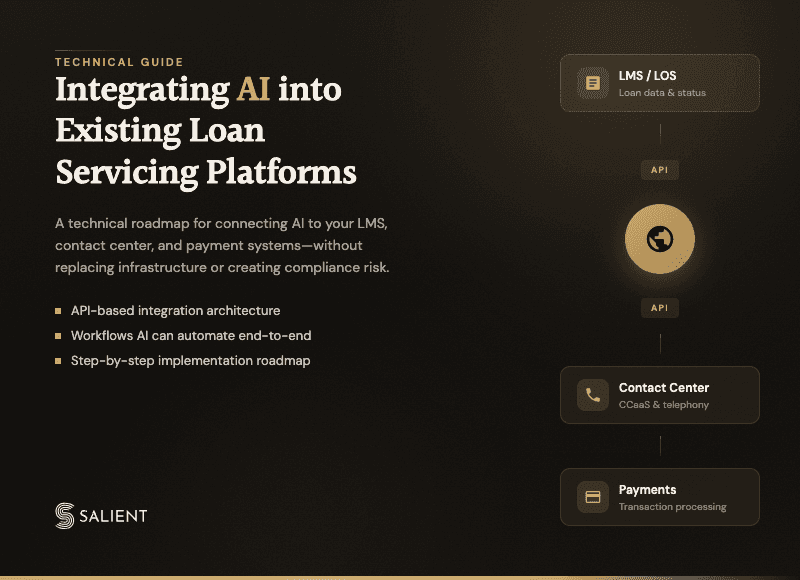
Salient integrates directly with your full production environment: your LMS, contact center platform, and payment processors. When a borrower connects, the AI agent ingests data on this borrower from your systems, identifies history such as past delinquency or hardship flags, references prior interactions, and contextualizes each conversation without making the borrower repeat information.
Real-Time Transaction Execution
AI agents execute workflows, not just answer questions. Today's borrowers expect instant approvals, self-service options, and personalized treatment. AI enables the real-time decisions and tailored repayment options that meet these expectations without adding headcount.
Secure Payments: Accept payments by phone using compliant card and ACH protocols.
Instant Verification: Authenticate borrowers against real-time LMS data.
Hardship Processing: Guide borrowers through hardship options and document necessary records directly in your system of record.
Leading implementations achieve full automation of these workflows, minimizing manual reviews and cutting risk in borrower interactions.
Compliance-First Automation
Not all AI agents are built for compliance, but Salient is. Salient's AI voice agents deliver "compliance-first" operations, ensuring every required disclosure gets issued, every phrase is delivered verbatim, and every action is logged.
Human agents, even well-trained ones, can drift from approved scripting, miss key disclosures, or alter process steps under stress. Properly configured AI agents with appropriate guardrails consistently stick to the compliance blueprint, protecting lenders from fines and creating a complete, auditable record with every call. Disputes and chargebacks get managed with precise documentation, closing known vulnerabilities and reducing liability exposure.
One of Salient's clients achieved 50% cost savings on confirmation calls while maintaining 100% compliance coverage across all interactions.
The Strategic Window for Adoption
The shift to AI-driven servicing is underway, and a widening gap is opening between institutions that move now and those left behind. According to Experian, 89% of financial institutions state that AI will play a critical role across the lending lifecycle. Early adopters are using AI to grow volume, boost conversion, and deliver personalized borrower experiences. Early adopters report:
Reduced Operational Costs: AI agents scale on demand, cutting cost per interaction dramatically. Leading implementations report 30-40% operating expense reductions by replacing manual touchpoints across the loan lifecycle.
Improved Risk Management: Predictive analytics help servicers anticipate delinquency, segment risk, and prioritize accounts, improving cure rates and minimizing charge-offs.
Improved Compliance: Automated flows significantly reduce costly violations.
Instant Scalability: No recruiting bottlenecks; AI flexes to meet surges and lulls effortlessly.
Securing the Future of Servicing
The operational reality of loan servicing has changed. The model of scaling through headcount is economically unsustainable. Rising costs, persistent turnover, and intensifying compliance requirements demand a fundamentally different approach.
AI voice agents aren't future technology; they're operational infrastructure at institutions servicing hundreds of thousands of loans today. Deploying this technology stabilizes operations, insulates institutions from rising wages and turnover, and achieves complete transparency across transactional and compliance workflows.
The shift to AI-driven servicing is already happening. Institutions that adopt now gain operational efficiency, compliance consistency, and cost advantages that compound over time